
.png)
Some advocacy programs never get off the ground.
Shannon Howard has a theory about why. It usually comes down to one thing: whether your customers actually know how to be successful with your product, and whether your team has the systems to scale that success.
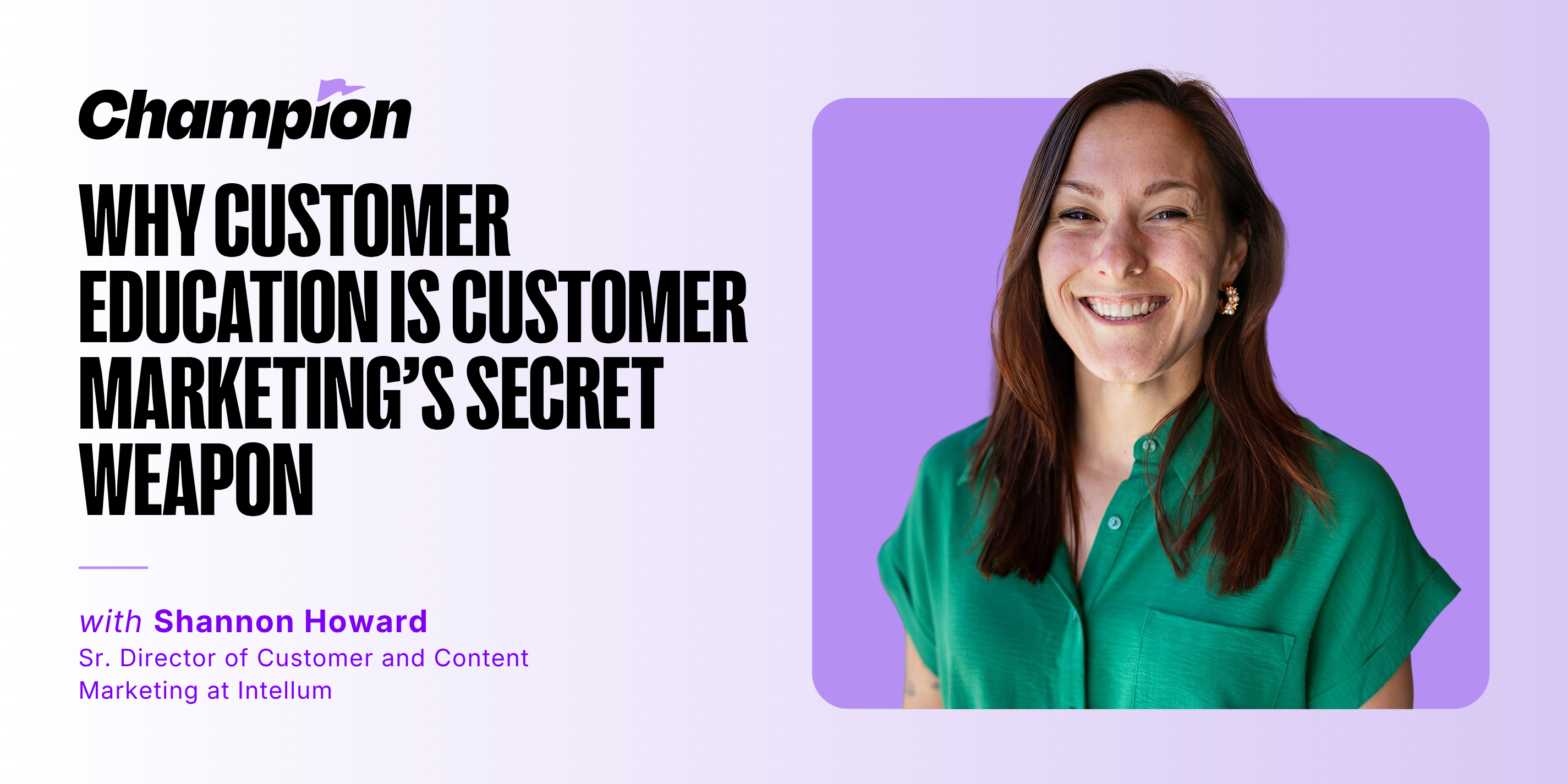
Shannon is the Sr. Director of Customer & Content Marketing at Intellum. She's spent her career at the intersection of two functions that rarely get talked about together: Customer Marketing and Customer Education. In a recent conversation with Champion Co-founder & CEO, Jeff Reekers, she makes the case for why that intersection is one of the most underutilized growth levers in B2B.
Customer Education is a Growth Function
Most companies treat customer education like a support function. Shannon treats it like a revenue function.
"No new customer comes in that didn't touch an existing customer. Customer education is critical to any go-to-market strategy that you have. You can have a product-led strategy, but if people don't know how to use your product, good luck keeping them. Good luck getting referrals, good luck expanding them into other product modules."
That reframes everything. Customer education isn't just about onboarding. It's not just about deflecting support tickets.
It feeds retention, expansion, and advocacy, all at once.
If customers don't know how to be successful, they won't stay. And if they don't stay, they won't advocate.
These Two Teams Need to Be Working Together
In most organizations, customer education lives in customer success. Customer marketing lives in marketing. They operate in silos, with little visibility into what the other team is building or distributing.
Shannon sees this as a massive missed opportunity, and she's specific about how the partnership should work.
Customer education does the needs analysis. It asks: what do customers actually need to know? Where are they getting stuck? What questions keep surfacing in support tickets and community forums? From there, it builds the content that drives real behavior change: onboarding materials, product release guides, skills enablement, etc.
Customer marketing handles distribution and delivery. It asks: who needs this content, when do they need it, and how do we get the right content to the right person at the right time?
When these two functions operate together, the impact compounds. Education content builds advocates. Advocacy insights inform what education content gets created next. The loop tightens.
"I really see this partnership here... these are sister teams that need to be working really closely together because one can inform the other, and I think the two of them together creates that one plus one equals three."
The Education-Led Growth Maturity Model
Shannon recently released a framework to help organizations assess where their customer education program actually stands, and what it takes to level it up.
The model is built on seven pillars:
- Business outcomes: What is education trying to drive?
- Audience: Who are you educating? Customers, partners, employees, prospects?
- Initiatives: What types of programs? Onboarding, certification, skills enablement?
- Content and resources: What exists, and where are the gaps?
- Delivery: How is content being served up and consumed?
- Marketing and engagement: How are you promoting and distributing that content?
- Measurement and continuous improvement: How do you close the feedback loop?
Programs are mapped across four stages: ad hoc, foundational, strategic, and transformational. The goal isn't to shame anyone at the early stages, it's to give customer education leaders a concrete business case for investment and the language to make it.
How to Build Alignment Without Waiting for a Green Light
Getting the rest of the organization to understand why your work matters is one of the hardest parts of customer marketing. Shannon has a practical playbook for it.
Build executive relationships before you need them. She schedules regular one-on-ones with sales leaders, account management executives, and individual reps. Not just when she needs something, but consistently. She shows up, shares what she's working on, and asks what's keeping them up at night.
Do internal marketing. Customer marketing teams spend enormous energy marketing externally and almost none marketing internally. Shannon flips that — treating internal stakeholders like an audience that needs to understand the value of her programs.
Don't wait for unanimous approval. If there's no clear yes but there's 80% confidence, keep moving. Waiting for full alignment that may never come is how programs stall.
Use strategy briefs to create visible alignment. Outline the problem, expected impact, potential solutions, and resources required. Create a structured moment for cross-functional input without requiring everyone in the same room.
Customer Journey Mapping Doesn't Have to Be a Six-Month Project
Shannon is realistic about journey mapping. Full-blown, executive-sponsored exercises are rare. What actually happens (and what still works) is a faster, more focused version she calls "quick and dirty journey mapping."
It starts with personas: understanding the difference between buyers, program owners, and admins. Three distinct audiences with different needs, different questions, and different success metrics. From there, she maps lifecycle stages: implementation, onboarding, ongoing adoption, renewal, and expansion.
The output isn't a polished deck, it's clarity. What content needs to exist, what's missing, and how to sequence the experience so customers aren't overwhelmed and aren't left without what they need.
Building a Presence in the Customer Marketing Community
Shannon has built one of the most recognized voices in this space.
Her advice for others trying to do the same:
Consistency beats frequency. The algorithm rewards consistency. So do relationships. Pick a cadence you can sustain and stick to it.
You know more than you think. Imposter syndrome is nearly universal in this space. But the same insight, delivered in a different voice, can reach someone who wouldn't have connected with how someone else said it.
Repurpose ruthlessly. A single conversation in a podcast, a Slack thread, a team meeting contains more content than most people realize. Build the habit of pulling it out and sharing it consistently.
The Takeaways
Don't separate advocacy from education. Customers who know how to be successful become your best advocates. The two are inseparable.
- Bridge the gap between customer education and customer marketing. These teams inform each other. Treat them as sister functions, not separate departments.
- Use the ELG Maturity Model to build your business case. If you're struggling to articulate the value of customer education to leadership, the framework gives you the language to do it.
- Build internal relationships before you need them. Influence is the currency of customer marketing. Invest in it continuously.
- Show up consistently. In programs, in content, in relationships… consistency compounds.
About Champion
Champion is an AI-powered customer advocacy platform that helps B2B companies identify, activate, and mobilize their most passionate customers. Our mission is to make trust the most powerful engine for business growth, using the voices and relationships of your happiest customers to make business more human.
Customers who know how to succeed become your most powerful advocates. Champion helps you identify those advocates, activate them at the right moment, and track the impact on revenue.
See how it works → Book a Demo


