
Guides

Making the Shift: From Reactive Support to Strategic Revenue Drivers

Here's a story that probably sounds familiar to Customer Marketers. 

A few years ago, Jeff Reekers, now CEO here at Champion, was sitting in a budget planning meeting at a previous company. His team had just run a survey of customers at deal close and found that 30-40% of new business came from word of mouth and referrals. Meanwhile, the lion's share of the marketing budget was going to paid ads with last-touch attribution. The CFO loved the paid ads because every dollar was attributed to an outcome.

That massive impact of customer advocacy? It didn't come up once in the budget conversation.

This is the defining challenge of Customer Marketing today. The function sits on a gold mine of revenue potential, but it’s constantly overshadowed. Not because the value isn't real, but because Customer Marketers haven't been positioned to make it visible.

The good news is that's changing. Customer Marketers across industries are making the shift from reactive executors and overlooked contributors to proactive strategists and indispensable revenue drivers. 

And they're doing it without massive budget increases or organizational overhauls.

Last year, we gathered with some of the brightest minds in the industry and established the Customer Marketing Manifesto, outlining the future of the CMA function and how we expect it to impact the future of business.

But, getting there is easier said than done. Let’s talk about how to break the cycle. 

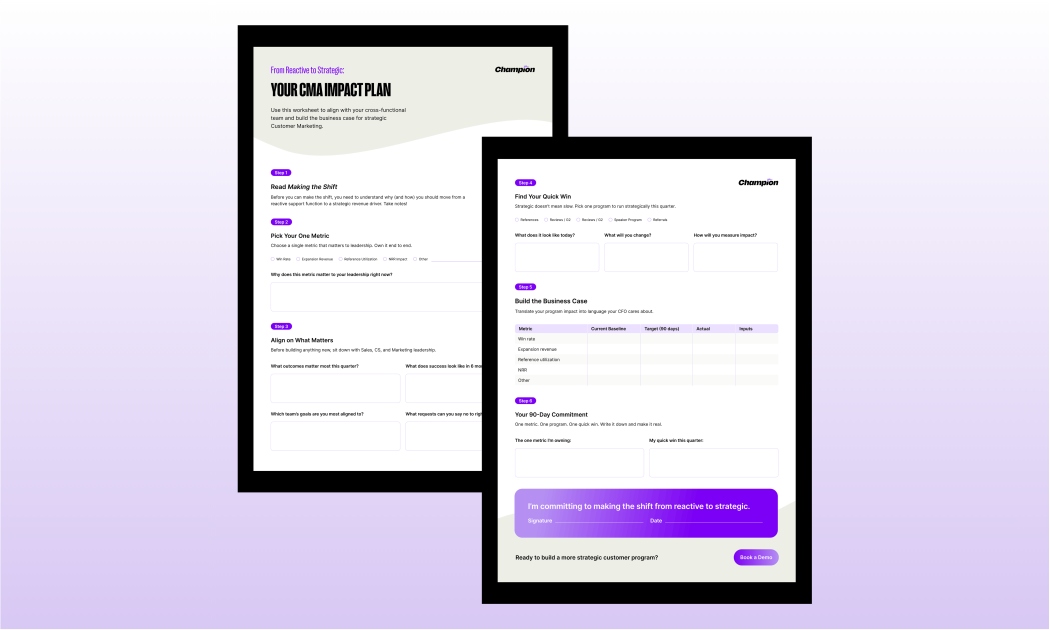
Get your bonus Impact Planning Worksheet
Why Customer Marketers Often Feel Stuck

Because most CMA roles open as a result of a team overwhelmed with advocacy requests, odds are, you’re already starting your role feeling behind.

Most of these roles are defined by outputs:

  • Number of Case Studies
  • Number of Active Advocates
  • References Completed by Quarter

You inherit responsibilities that feel incredibly manual, and are very hard to scale, especially without resources. You’re too busy producing and fulfilling tasks, that you can never step back and build something strategic. You’re burned out and your organization is missing out on massive value.

Emily Cid, Champion’s Sr. Director of Customer Success, said it best:

“You make a thousand lists a year for everyone else's programs. Instead of leading, you're facilitating."

If you relate to this, you are not alone. It might be time for you to make a shift. 

The Cost of Staying Tactical As a Customer Marketer

So what’s actually at stake here? When this function is operating reactively, you’re leaving revenue on the table, and a lot of it. 

Consider the costs:

You’re not building scalable programs. When every case study request is a one-off scramble, and every reference search starts from scratch, you’re not able to create systems that get easier and more effective over time. You’re always in the weeds and it becomes very difficult to capacity plan. 

You can’t measure what matters. Because you’re so in the weeds, focusing on activity metrics (# of new case studies, referrals submitted, references filled) seems like the best way for you to demonstrate your impact, but that impact doesn’t translate to leadership. It takes time and collaboration across your org to understand how your programs can impact business goals, and to build the proper reporting to show customer impact. When you’re chasing down advocates, you don’t have the time to spend here. 

Your best advocates get burnt out, fast. Without a clear strategy to build a strong list of advocates, maintain its growth, and ensure you aren’t over-asking, you’ll keep going back to the same handful of customers for every request. Eventually, they tune out or leave.

Leadership underinvests in your department. Like in Jeff’s budgeting story, if Customer Marketing's impact isn't visible in the language of finance, think pipeline influenced, revenue generated, retention rates, it’s excluded from the conversation. You can be doing extraordinary work that isn't recognized because you haven't connected it to the numbers that matter to your CFO.

NRR suffers. This might be the most expensive blind spot in Customer Marketing, because it’s a strong lagging indicator of two things: you aren’t closing the right customers and/or your customers aren’t getting enough value to renew and expand with you. The problem is, you don’t realize NRR is being impacted until a year or so after the deal closes.

Tyler Calder, CMO at Partnerstack, recently described a rather common scenario where ELT was saying NRR is an issue. A lot of finger pointing was happening, but no one pointed the finger at marketing, because no one saw Marketing's role as affecting NRR.

Here's the thing: marketing is actually in the best position to fix net retention problems. But when Customer Marketing is stuck in reactive mode, churning out case studies and filling reference requests, they're not thinking about how to drive expansion revenue or improve retention rates through strategic customer engagement.

When Customer Marketers operate strategically, they can impact NRR through targeted programs like understanding which accounts have multiple champions versus those that don't, analyzing renewal rates by advocate engagement, and building customer-to-customer reference programs that strengthen retention.

No one may be looking at you to help with a solution, but you know you can have an impact. Volunteer to come up with a solution and go do it. 

Pro tip: If you want to make the NRR argument to leadership, pull your renewal data and segment it by advocate vs. non-advocate accounts. The delta will make the case for you. 

What does “Making the Shift” actually look like? 

It’s too easy for Customer Marketers to get stuck in a reactive loop. Chasing down references, begging for case studies, knocking on everyone’s door. Everything feels siloed.

The shift is realizing your impact should be far beyond tactical support. Customer Marketing is a strategic lever for building trust, fueling expansion, and driving revenue directly.

Here are some real examples of what it looks like to make the shift from reactive to strategic: 

Reactive
Proactive
Waiting for reference requests
Building a bench of reference-ready customers
Scrambling for customer proof
Pre-packaging stories by use case or segment
One-off asks from Sales
Scalable playbooks and enablement content
Untracked, anecdotal wins
Clear program attribution
Last minute event speaker sourcing
Curated speaker pipeline, updated quarterly
Guessing what message will resonate
Championing VOC to internal teams to align on messaging

Think about it this way: a reactive Customer Marketer asks “How many references did we fill this month?” While a strategic Customer Marketer asks, “How did our reference program impact the overall win rate for our Enterprise segment?” 

You shift from focusing on program outputs to business impact. 

Pro tip: Don't try to shift everything at once. Pick one area, like references, reviews, or your speaker program, and run it strategically for one quarter. Use that result as proof of concept to expand. 

The Skills That Matter

If you’re looking to become more strategic and earn your seat at the table, or if you’re looking to hire a Customer Marketer who can operate at this level, there are specific qualities that matter more than others.

Curiosity tops the list. The best Customer Marketers are exceptionally perceptive. They’re great listeners, but more importantly, they ask great questions. They dig into why something isn’t working and are always thinking of ways being closer to the customer can fix it. As Gianna Scorsone, COO of Champion, loves to say: “Get curious, not critical.”

You need to understand business data & finance. Learn what a P&L looks like and how your programs can drive more profitability for your organization. You should be fluent in the metrics your CEO & CFO care about: Customer Acquisition Cost (CAC), Lifetime Value (LTV), Net Retention Rate (NRR), Annual Recurring Revenue (ARR), etc. This will help you position your programs in a way that the C-Suite leaders can see the impact they are having directly on the business.

Learn to be a storyteller. Numbers matter, but stories close deals and win you dollars. The ability to not only understand data, but take it and weave it into narratives that resonate with different stakeholders will get you buy-in across the org on whatever you’re trying to do. Don’t report that your program “influenced” $2M in pipeline, tell qualitative stories on how your reference program closed 3 deals that were on the fence, and led the enterprise sales team to meet their quota. 

Pro tip: Find out which deals closed recently where a customer reference or case study played a role, and interview the AE. Their language is your best material for framing impact to leadership. 

Have a bias toward action. We’ve all heard the saying “progress over perfection,” and that’s absolutely true here. Don’t let the quest for perfection slow you down and prevent you from making/proving impact. Great Customer Marketers move fast when they see opportunity, they don’t wait to be told what to do, they get cross-functional alignment on what success looks like, and iterate as they learn. Be comfortable with imperfection in service of momentum. 

Be great at internal selling. Making the shift requires buy-in from sales, marketing, customer success, and the C-suite. You need to constantly be selling internally. Understand what each stakeholder cares about, and position your programs and impact accordingly.

Finally, be tough. Everyone has opinions about marketing. You’ll be getting feedback from every direction, both positive and negative. Take it in stride, extract what’s useful, don’t make assumptions, and keep moving forward with conviction. You are one of the closest in your organization to the customer, you know what you’re doing. Trust your instincts!

How to Become a More Strategic Customer Marketer

If you’re reading this and thinking, this all sounds great, but I am buried in reference requests right now and I have no clue where to start…

We’ve got you. 

1. Have a conversation about goals. 

Before you build anything new, align on why your work exists. Sit down with Sales, CS, and Marketing leadership and ask a simple question: what outcomes actually matter this quarter and this year? Your job is not necessarily to say yes to every request, it’s to connect customer advocacy to real business goals. When everyone agrees on the destination, it becomes much easier to say no to work that doesn’t move the needle.

2. Pick one metric and own it. 

Trying to own everything guarantees you own nothing. Choose a single metric that matters to leadership and anchor your work to it. That might be win rate for late-stage deals, expansion revenue influenced by advocates, or reference utilization by segment. Own it end to end. Build programs around it, report on it consistently, and use it as your lens for prioritization.

Pro tip: "Pick one metric" only works if you align with Sales or CS, not in isolation. A metric your team owns but nobody else tracks doesn't change your seat at the table. 

3. Look out for quick wins. 

Strategic doesn’t mean slow. Look for opportunities where small changes can unlock outsized impact. That could be tagging advocates by segment so sales can self-serve, documenting a repeatable reference process, or re-engaging dormant champions before a big launch. Quick wins buy you credibility, momentum, and trust, which gives you space to invest in bigger bets.

4. Predict what you’ll need and build an advocacy pipeline. 

Reactive Customer Marketing means you’re always scrambling. Strategic Customer Marketing plans ahead. Work backwards from upcoming launches, target segments, renewal cycles, and pipeline goals to predict the advocacy you’ll need months from now. Then build a pipeline of customers who are nurtured, activated, and ready before the request ever comes in. This is how you stop burning out your best champions.

5. Invest in the right tools. 

You can’t scale strategy on spreadsheets and Slack messages alone. The right tools help you systematize advocate management, track impact, and make your programs visible across the org. More importantly, they free up your time to think, analyze, and build instead of chasing requests. Tools don’t replace strategy, but they make it possible.

6. Become high leverage (or, learn to say no). 

This is the hardest shift, and the most important one. High-leverage Customer Marketers protect their time so they can focus on work that compounds. That means saying no, or not now, to one-off requests that don’t align to goals. Every yes should support a program, a metric, or a strategy. When you make this shift, you stop being a service desk and start becoming a growth leader.

Jeff’s story about referrals' invisible influence isn’t just about a budget meeting. It's about what happens when the people closest to the customer don't have the language or the data to make that value visible. That's the shift we need to make. From invisible to indispensable.

Your customers are already your best growth channel. They're ready to refer, advocate, and close deals for you. This activation problem is exactly what strategic Customer Marketers are built to solve. Stop running a leaky bucket business. Start building a customer revenue engine.

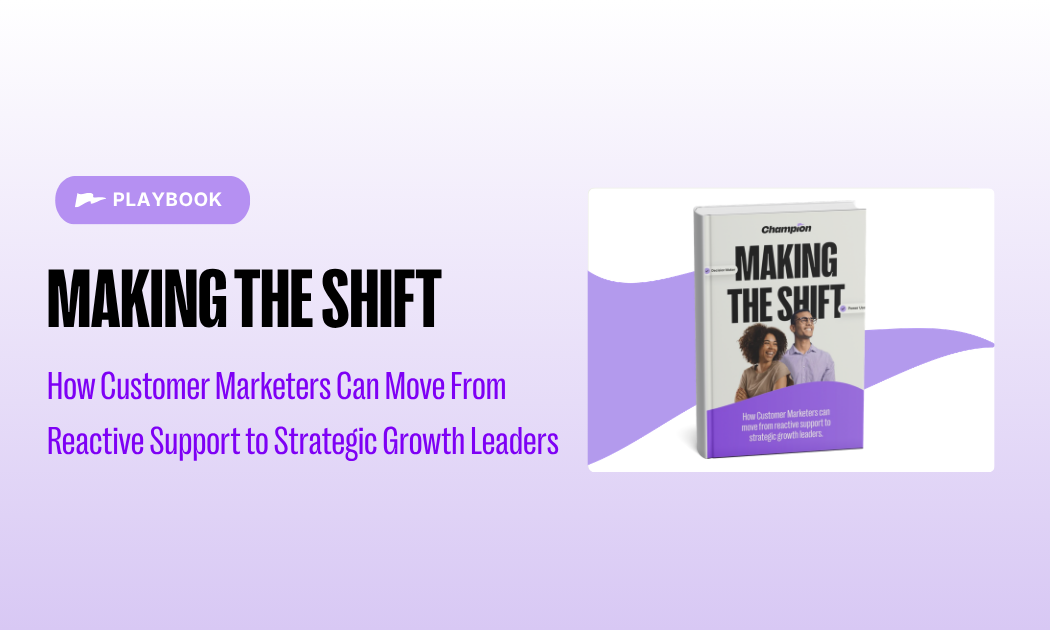
Share a few contact details and we'll provide you with a download of the ebook.
Oops! Something went wrong while submitting the form.

Making the Shift: From Reactive Support to Strategic Revenue Drivers

Champion
Goal
Key Capability
Impact

Here's a story that probably sounds familiar to Customer Marketers. 

A few years ago, Jeff Reekers, now CEO here at Champion, was sitting in a budget planning meeting at a previous company. His team had just run a survey of customers at deal close and found that 30-40% of new business came from word of mouth and referrals. Meanwhile, the lion's share of the marketing budget was going to paid ads with last-touch attribution. The CFO loved the paid ads because every dollar was attributed to an outcome.

That massive impact of customer advocacy? It didn't come up once in the budget conversation.

This is the defining challenge of Customer Marketing today. The function sits on a gold mine of revenue potential, but it’s constantly overshadowed. Not because the value isn't real, but because Customer Marketers haven't been positioned to make it visible.

The good news is that's changing. Customer Marketers across industries are making the shift from reactive executors and overlooked contributors to proactive strategists and indispensable revenue drivers. 

And they're doing it without massive budget increases or organizational overhauls.

Last year, we gathered with some of the brightest minds in the industry and established the Customer Marketing Manifesto, outlining the future of the CMA function and how we expect it to impact the future of business.

But, getting there is easier said than done. Let’s talk about how to break the cycle. 

Get your bonus Impact Planning Worksheet

Why Customer Marketers Often Feel Stuck

Because most CMA roles open as a result of a team overwhelmed with advocacy requests, odds are, you’re already starting your role feeling behind.

Most of these roles are defined by outputs:

  • Number of Case Studies
  • Number of Active Advocates
  • References Completed by Quarter

You inherit responsibilities that feel incredibly manual, and are very hard to scale, especially without resources. You’re too busy producing and fulfilling tasks, that you can never step back and build something strategic. You’re burned out and your organization is missing out on massive value.

Emily Cid, Champion’s Sr. Director of Customer Success, said it best:

“You make a thousand lists a year for everyone else's programs. Instead of leading, you're facilitating."

If you relate to this, you are not alone. It might be time for you to make a shift. 

The Cost of Staying Tactical As a Customer Marketer

So what’s actually at stake here? When this function is operating reactively, you’re leaving revenue on the table, and a lot of it. 

Consider the costs:

You’re not building scalable programs. When every case study request is a one-off scramble, and every reference search starts from scratch, you’re not able to create systems that get easier and more effective over time. You’re always in the weeds and it becomes very difficult to capacity plan. 

You can’t measure what matters. Because you’re so in the weeds, focusing on activity metrics (# of new case studies, referrals submitted, references filled) seems like the best way for you to demonstrate your impact, but that impact doesn’t translate to leadership. It takes time and collaboration across your org to understand how your programs can impact business goals, and to build the proper reporting to show customer impact. When you’re chasing down advocates, you don’t have the time to spend here. 

Your best advocates get burnt out, fast. Without a clear strategy to build a strong list of advocates, maintain its growth, and ensure you aren’t over-asking, you’ll keep going back to the same handful of customers for every request. Eventually, they tune out or leave.

Leadership underinvests in your department. Like in Jeff’s budgeting story, if Customer Marketing's impact isn't visible in the language of finance, think pipeline influenced, revenue generated, retention rates, it’s excluded from the conversation. You can be doing extraordinary work that isn't recognized because you haven't connected it to the numbers that matter to your CFO.

NRR suffers. This might be the most expensive blind spot in Customer Marketing, because it’s a strong lagging indicator of two things: you aren’t closing the right customers and/or your customers aren’t getting enough value to renew and expand with you. The problem is, you don’t realize NRR is being impacted until a year or so after the deal closes.

Tyler Calder, CMO at Partnerstack, recently described a rather common scenario where ELT was saying NRR is an issue. A lot of finger pointing was happening, but no one pointed the finger at marketing, because no one saw Marketing's role as affecting NRR.

Here's the thing: marketing is actually in the best position to fix net retention problems. But when Customer Marketing is stuck in reactive mode, churning out case studies and filling reference requests, they're not thinking about how to drive expansion revenue or improve retention rates through strategic customer engagement.

When Customer Marketers operate strategically, they can impact NRR through targeted programs like understanding which accounts have multiple champions versus those that don't, analyzing renewal rates by advocate engagement, and building customer-to-customer reference programs that strengthen retention.

No one may be looking at you to help with a solution, but you know you can have an impact. Volunteer to come up with a solution and go do it. 

Pro tip: If you want to make the NRR argument to leadership, pull your renewal data and segment it by advocate vs. non-advocate accounts. The delta will make the case for you. 

What does “Making the Shift” actually look like? 

It’s too easy for Customer Marketers to get stuck in a reactive loop. Chasing down references, begging for case studies, knocking on everyone’s door. Everything feels siloed.

The shift is realizing your impact should be far beyond tactical support. Customer Marketing is a strategic lever for building trust, fueling expansion, and driving revenue directly.

Here are some real examples of what it looks like to make the shift from reactive to strategic: 

Reactive
Proactive
Waiting for reference requests
Building a bench of reference-ready customers
Scrambling for customer proof
Pre-packaging stories by use case or segment
One-off asks from Sales
Scalable playbooks and enablement content
Untracked, anecdotal wins
Clear program attribution
Last minute event speaker sourcing
Curated speaker pipeline, updated quarterly
Guessing what message will resonate
Championing VOC to internal teams to align on messaging

Think about it this way: a reactive Customer Marketer asks “How many references did we fill this month?” While a strategic Customer Marketer asks, “How did our reference program impact the overall win rate for our Enterprise segment?” 

You shift from focusing on program outputs to business impact. 

Pro tip: Don't try to shift everything at once. Pick one area, like references, reviews, or your speaker program, and run it strategically for one quarter. Use that result as proof of concept to expand. 

The Skills That Matter

If you’re looking to become more strategic and earn your seat at the table, or if you’re looking to hire a Customer Marketer who can operate at this level, there are specific qualities that matter more than others.

Curiosity tops the list. The best Customer Marketers are exceptionally perceptive. They’re great listeners, but more importantly, they ask great questions. They dig into why something isn’t working and are always thinking of ways being closer to the customer can fix it. As Gianna Scorsone, COO of Champion, loves to say: “Get curious, not critical.”

You need to understand business data & finance. Learn what a P&L looks like and how your programs can drive more profitability for your organization. You should be fluent in the metrics your CEO & CFO care about: Customer Acquisition Cost (CAC), Lifetime Value (LTV), Net Retention Rate (NRR), Annual Recurring Revenue (ARR), etc. This will help you position your programs in a way that the C-Suite leaders can see the impact they are having directly on the business.

Learn to be a storyteller. Numbers matter, but stories close deals and win you dollars. The ability to not only understand data, but take it and weave it into narratives that resonate with different stakeholders will get you buy-in across the org on whatever you’re trying to do. Don’t report that your program “influenced” $2M in pipeline, tell qualitative stories on how your reference program closed 3 deals that were on the fence, and led the enterprise sales team to meet their quota. 

Pro tip: Find out which deals closed recently where a customer reference or case study played a role, and interview the AE. Their language is your best material for framing impact to leadership. 

Have a bias toward action. We’ve all heard the saying “progress over perfection,” and that’s absolutely true here. Don’t let the quest for perfection slow you down and prevent you from making/proving impact. Great Customer Marketers move fast when they see opportunity, they don’t wait to be told what to do, they get cross-functional alignment on what success looks like, and iterate as they learn. Be comfortable with imperfection in service of momentum. 

Be great at internal selling. Making the shift requires buy-in from sales, marketing, customer success, and the C-suite. You need to constantly be selling internally. Understand what each stakeholder cares about, and position your programs and impact accordingly.

Finally, be tough. Everyone has opinions about marketing. You’ll be getting feedback from every direction, both positive and negative. Take it in stride, extract what’s useful, don’t make assumptions, and keep moving forward with conviction. You are one of the closest in your organization to the customer, you know what you’re doing. Trust your instincts!

How to Become a More Strategic Customer Marketer

If you’re reading this and thinking, this all sounds great, but I am buried in reference requests right now and I have no clue where to start…

We’ve got you. 

1. Have a conversation about goals. 

Before you build anything new, align on why your work exists. Sit down with Sales, CS, and Marketing leadership and ask a simple question: what outcomes actually matter this quarter and this year? Your job is not necessarily to say yes to every request, it’s to connect customer advocacy to real business goals. When everyone agrees on the destination, it becomes much easier to say no to work that doesn’t move the needle.

2. Pick one metric and own it. 

Trying to own everything guarantees you own nothing. Choose a single metric that matters to leadership and anchor your work to it. That might be win rate for late-stage deals, expansion revenue influenced by advocates, or reference utilization by segment. Own it end to end. Build programs around it, report on it consistently, and use it as your lens for prioritization.

Pro tip: "Pick one metric" only works if you align with Sales or CS, not in isolation. A metric your team owns but nobody else tracks doesn't change your seat at the table. 

3. Look out for quick wins. 

Strategic doesn’t mean slow. Look for opportunities where small changes can unlock outsized impact. That could be tagging advocates by segment so sales can self-serve, documenting a repeatable reference process, or re-engaging dormant champions before a big launch. Quick wins buy you credibility, momentum, and trust, which gives you space to invest in bigger bets.

4. Predict what you’ll need and build an advocacy pipeline. 

Reactive Customer Marketing means you’re always scrambling. Strategic Customer Marketing plans ahead. Work backwards from upcoming launches, target segments, renewal cycles, and pipeline goals to predict the advocacy you’ll need months from now. Then build a pipeline of customers who are nurtured, activated, and ready before the request ever comes in. This is how you stop burning out your best champions.

5. Invest in the right tools. 

You can’t scale strategy on spreadsheets and Slack messages alone. The right tools help you systematize advocate management, track impact, and make your programs visible across the org. More importantly, they free up your time to think, analyze, and build instead of chasing requests. Tools don’t replace strategy, but they make it possible.

6. Become high leverage (or, learn to say no). 

This is the hardest shift, and the most important one. High-leverage Customer Marketers protect their time so they can focus on work that compounds. That means saying no, or not now, to one-off requests that don’t align to goals. Every yes should support a program, a metric, or a strategy. When you make this shift, you stop being a service desk and start becoming a growth leader.

Jeff’s story about referrals' invisible influence isn’t just about a budget meeting. It's about what happens when the people closest to the customer don't have the language or the data to make that value visible. That's the shift we need to make. From invisible to indispensable.

Your customers are already your best growth channel. They're ready to refer, advocate, and close deals for you. This activation problem is exactly what strategic Customer Marketers are built to solve. Stop running a leaky bucket business. Start building a customer revenue engine.

Share On:
Share on LinkedIn
Share on Twitter