Guides

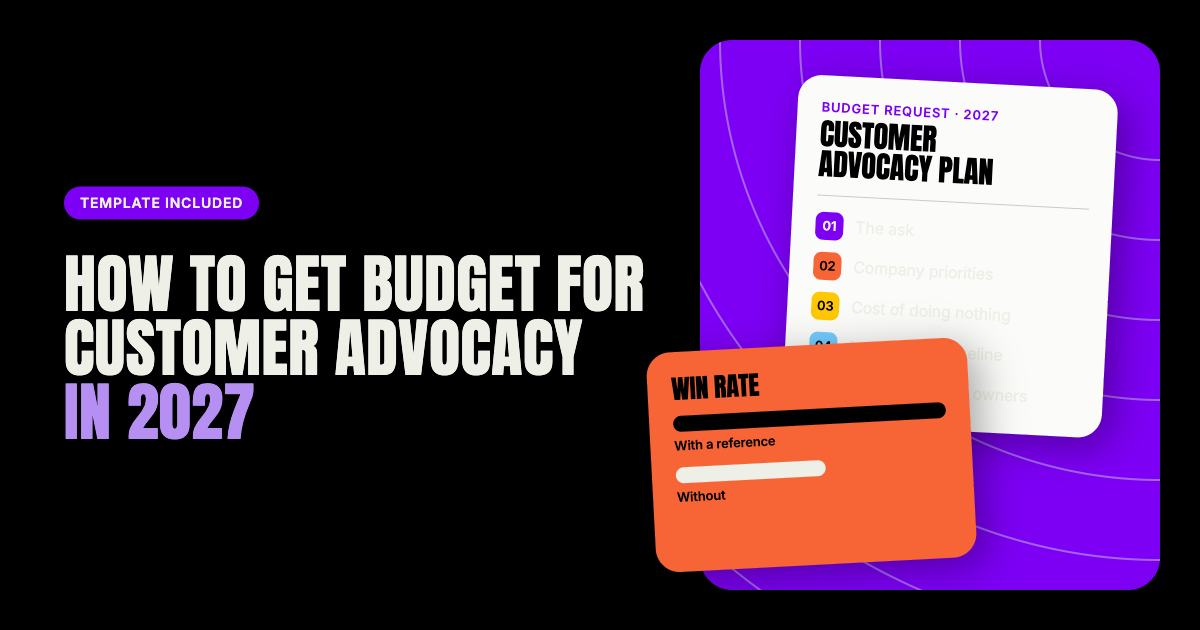
How to Get Budget for Customer Advocacy in 2027 (Template Included!)

Every customer marketer has a story about a customer who saved a deal, or a reference call that got a stalled opportunity moving, or a case study that made its way around a buying committee. You know which customers would go to bat for you, and which ones already have.

But your leadership team rarely has that same view. All they see is a line item when they have a mandate to cut costs. With 2027 budgets being set right now, you need to tie your programs to the business outcomes your exec team cares about. 

Here’s how to get that buy-in, using the same frameworks we use with our customers. There's even a template at the end you can download and make your own. If you'd like to partner on making your business case, we'd love to help! Get a free CMA strategy consultation with us here.

Why advocacy budget requests stall

Most pushback on advocacy budget comes back to four questions:

  • Why can't we just do this ourselves?
  • What's the return?
  • How does this tie to what we're trying to do next year?
  • Are we actually ready? 

A lot of requests skip these and lead with activity metrics instead. Things like 50 references, 12 case studies, and 200 new reviews mean something to you, but to an executive, they don't say much about the impact on the business. 

As community and customer marketing consultant Brian Oblinger put it in our Metrics That Matter webinar, "Numbers without context don't land." Before any number goes in front of leadership, ask yourself: what business outcome does this actually move? If you can't answer it, leave the number out.

Now, the step-by-step guide to getting your 2027 budget approved. 

Step 1: Start with your company's big bets, not your program

Your leadership team is already focused on a short list of company goals for next year. Your plan should start there.

Write down your company's top priorities for 2027, then sort them into three revenue motions:

  • Land: winning new customers. Think: win rate, deal velocity, and pipeline.
  • Expand: growing existing accounts. Look at how your programs drive upsell, cross-sell, and adoption of new products.
  • Retain: keeping the customers you have. How can you influence renewal rate, churn, or NRR? 

If lowering cost to serve is a big focus for your leadership team, add it as a fourth motion. Then work out how advocacy supports each one.

For each priority, answer four questions: What's the goal? What has to change to hit it? Which advocacy program helps make that change? How will you measure it?

A few examples:

  • Grow enterprise win rate: reps need peer proof late in deals, so build a reference program matched by industry and use case, and track win rate on deals with a reference vs. without.
  • Launch a new product line: early buyers want to see someone like them using it, so run an early adopter program for reviews and short stories, and track pipeline influenced on the new product.
  • Improve renewal rates: at-risk accounts need a reason to stay engaged, so invite key accounts into your advisory board and community, and track renewal rates for engaged vs. non-engaged accounts.

If you're not sure where your current programs fit, try the exercise from our Metrics That Matter webinar: list every program and asset you run, then map each one to a stage of the customer journey. It's a quick way to see where advocacy already touches revenue, and where there’s room to make a difference. 

Step 2: Show where you are today and the cost of inaction

Next, show the gap between where your program is today and where it needs to be.

Keep it short and honest. Good places to start:

  • How many customers could be advocates vs. how many you've actually activated
  • How long it takes to fill a reference request from ask to scheduled call
  • How many hours a week go into maintaining spreadsheets, chasing CSMs, and manual tracking
  • What share of your top 20 strategic accounts would take a reference call today
  • Where your review ratings sit on the sites your buyers check

We worked with one team that had between 1,000 and 2,000 potential advocates in its customer base and five published case studies. The first question from leadership was why that many potential advocates didn’t show up in pipeline, win rates, or renewals. A gap like that is worth putting in front of leadership and explaining how you can close it. 

Then outline what happens if nothing changes. Deals reach late stage without customer proof. Reps lean on whoever they happen to know. When a CSM or AE leaves, their customer relationships go with them. None of this shows up as a line item, but it can have major impact on which deals close or which accounts renew. Sometimes doing nothing is more costly than trying something new. 

Step 3: Pick your metrics based on where you are

You don't need a perfect attribution model to ask for budget. You need a few numbers you can stand behind.

Start with where your measurement stands today. In our practitioner's playbook on measuring customer marketing impact, we break it into three stages:

  • Tracking Activity: you have a consistent baseline of what your program does.
  • Influencing Pipeline: you can connect program activity to deals.
  • Owning Revenue: your contribution is highly visible across the customer journey and shapes budget decisions.

Most teams asking for budget are somewhere between the first two stages, and that's okay. Be upfront about it, and frame the budget as what gets you to the next stage.

From there:

  • Pick one metric and own it. Report back consistently to show how you are moving the needle.
  • Use with vs. without comparisons. Win rate on deals with a reference vs. without. Renewal rate for advocate accounts vs. everyone else. As we wrote in Making the Shift, "The delta will make the case for you."
  • Directional is better than no data. Share how you are measuring outcomes and explain how the investment helps you prove cause over time. Early data can point to the direction you are moving, but it’s ok to not have enough hard data in the beginning stages.
  • Set a baseline now and check in at 6 and 12 months.
  • Show the executive view, not the program view. Leadership doesn't need your full dashboard. Spotlight what they care about most and be able to tell the story of your program.

Step 4: Lay out a 90-day plan with owners

Leadership will want to know what happens after they say yes to more money. A short plan with dates and owners answers that. We recommend keeping it to the first 90 days:

  • Days 1 to 30: get your data connected and find your advocates. Who are your strongest customers, based on product usage, sentiment, engagement, and past advocacy?
  • Days 31 to 60: pilot one or two programs tied directly to the priorities from Step 1.
  • Days 61 to 90: share your first impact report with leadership, and run an internal roadshow so every team knows what's in it for them.

Then name who else needs to be involved: RevOps for data, Sales and CS for nominations and customer context, and your executive sponsor. 

If those teams are already on board before your budget meeting, say so. That answers the readiness question before anyone asks it.

"Pursue shared goals, not just shared awareness," Kong’s Taylor Page told us in our conversation on full-stack customer marketing. If Sales has a stake in the outcome, your plan gets a lot easier to approve.

Also include rules of engagement: who can ask a customer for what, and how often. It shows leadership you're protecting your best customers from being burnt out.

Step 5: Compare your options honestly

Expect someone to ask why you can't build this in-house. Answer it directly by laying out the build v.s buy options side by side:

  • Keep doing what you're doing today
  • Build it in your CRM with spreadsheets and RevOps time
  • Hire another person to run it manually
  • Buy a platform

Weigh each of these by the four factors outlined in our piece on build, buy, or partner: time, cost, control, and strategic differentiation.

Building often looks cheaper up front, but be aware of ongoing costs like maintenance, data upkeep, and team training. It’s usually not V1 that’s the problem, it’s V40. 

Then add simple payback math. It doesn't need to be a full model. Try this simple formula:

"If advocacy influences [X] more deals at our average contract value of [$Y], this pays for itself at [Z] deals."

For most B2B companies, it doesn't take many deals. Our article on how to measure the ROI of customer advocacy walks through the formula with examples for references, job changes, and referrals.

Step 6: Get ahead of the hard questions

Write down the questions you expect, with a one or two line answer for each. The usual ones:

  • Why not build it ourselves?
  • Why now, and not next quarter?
  • What if it doesn't work?
  • Who owns this, and how much of their time will it take?
  • How will we know it's working?

It also helps to ask your boss before the meeting: "What would make you say no to this?" 

One customer marketer we worked with was pitching her CEO, who had a written list of the most common reasons he turns down new tools. She built her case around that list. Most leaders won't have it written down, but they'll usually tell you if you ask.

Pro tip: When you talk about results, tell the story of a specific deal: the one that was stuck until the right customer got on the phone. A pipeline number is easier to remember when there's a real deal behind it.

Step 7: Lead with the ask

Everything above should roll up into one page that covers:

  • What decision you need
  • How much, and for how long
  • By when
  • Which one or two outcomes it moves, with a target
  • Why now

Put this page first, so leadership knows what you're asking for from the start.

Don't hold the plan back waiting for perfect data, either. Perfection is the enemy of storytelling and gaining buy-in.

If you're new, or a team of one

If you're a few weeks into a new role, or running advocacy on your own, you might be asked for a strategy while you're still learning the business. A few things that help:

  • Pre-wire the room. Meet with key stakeholders one-on-one before the big meeting. No one should be hearing your plan for the first time in that meeting.
  • Find your data partner. Take your RevOps lead, or your CFO, to lunch. They have the data you need, and their support carries weight.
  • Borrow credibility. Use peer benchmarks and stories from companies like yours, and ask someone who has built a program before to pressure-test your plan.
  • Start with a pilot. One program and one clear metric is easier to approve than a full rollout, and it gives you proof for the next ask.

Download the template

We built a template following the steps above. Fill it in and drop it into your own deck. It includes:

  • A one-page summary of your ask
  • Your company priorities and where advocacy fits
  • Where you are today, and the cost of doing nothing
  • Your metrics, baseline, and check-ins
  • Your 90-day plan and owners
  • The options you considered
  • Risks and how you'll handle them

Where Champion fits

Champion helps customer marketing teams uncover the champions across their entire customer base, activate them where the business needs them, and report on the impact to pipeline and revenue.

When Gainsight rebuilt its reference program with Champion, it influenced $383K in ARR in its first 90 days. Matching a reference went from 8 days to 1.7 days, and scheduling went from 16 days down to 4. Read the full story.

Want a second set of eyes on your plan before you take it to leadership? Get a free CMA Strategy Consultation with our team.

‍

Share a few contact details and we'll provide you with a download of the ebook.
Oops! Something went wrong while submitting the form.

How to Get Budget for Customer Advocacy in 2027 (Template Included!)

Gianna Scorsone
Goal
Key Capability
Impact

Every customer marketer has a story about a customer who saved a deal, or a reference call that got a stalled opportunity moving, or a case study that made its way around a buying committee. You know which customers would go to bat for you, and which ones already have.

But your leadership team rarely has that same view. All they see is a line item when they have a mandate to cut costs. With 2027 budgets being set right now, you need to tie your programs to the business outcomes your exec team cares about. 

Here’s how to get that buy-in, using the same frameworks we use with our customers. There's even a template at the end you can download and make your own. If you'd like to partner on making your business case, we'd love to help! Get a free CMA strategy consultation with us here.

Why advocacy budget requests stall

Most pushback on advocacy budget comes back to four questions:

  • Why can't we just do this ourselves?
  • What's the return?
  • How does this tie to what we're trying to do next year?
  • Are we actually ready? 

A lot of requests skip these and lead with activity metrics instead. Things like 50 references, 12 case studies, and 200 new reviews mean something to you, but to an executive, they don't say much about the impact on the business. 

As community and customer marketing consultant Brian Oblinger put it in our Metrics That Matter webinar, "Numbers without context don't land." Before any number goes in front of leadership, ask yourself: what business outcome does this actually move? If you can't answer it, leave the number out.

Now, the step-by-step guide to getting your 2027 budget approved. 

Step 1: Start with your company's big bets, not your program

Your leadership team is already focused on a short list of company goals for next year. Your plan should start there.

Write down your company's top priorities for 2027, then sort them into three revenue motions:

  • Land: winning new customers. Think: win rate, deal velocity, and pipeline.
  • Expand: growing existing accounts. Look at how your programs drive upsell, cross-sell, and adoption of new products.
  • Retain: keeping the customers you have. How can you influence renewal rate, churn, or NRR? 

If lowering cost to serve is a big focus for your leadership team, add it as a fourth motion. Then work out how advocacy supports each one.

For each priority, answer four questions: What's the goal? What has to change to hit it? Which advocacy program helps make that change? How will you measure it?

A few examples:

  • Grow enterprise win rate: reps need peer proof late in deals, so build a reference program matched by industry and use case, and track win rate on deals with a reference vs. without.
  • Launch a new product line: early buyers want to see someone like them using it, so run an early adopter program for reviews and short stories, and track pipeline influenced on the new product.
  • Improve renewal rates: at-risk accounts need a reason to stay engaged, so invite key accounts into your advisory board and community, and track renewal rates for engaged vs. non-engaged accounts.

If you're not sure where your current programs fit, try the exercise from our Metrics That Matter webinar: list every program and asset you run, then map each one to a stage of the customer journey. It's a quick way to see where advocacy already touches revenue, and where there’s room to make a difference. 

Step 2: Show where you are today and the cost of inaction

Next, show the gap between where your program is today and where it needs to be.

Keep it short and honest. Good places to start:

  • How many customers could be advocates vs. how many you've actually activated
  • How long it takes to fill a reference request from ask to scheduled call
  • How many hours a week go into maintaining spreadsheets, chasing CSMs, and manual tracking
  • What share of your top 20 strategic accounts would take a reference call today
  • Where your review ratings sit on the sites your buyers check

We worked with one team that had between 1,000 and 2,000 potential advocates in its customer base and five published case studies. The first question from leadership was why that many potential advocates didn’t show up in pipeline, win rates, or renewals. A gap like that is worth putting in front of leadership and explaining how you can close it. 

Then outline what happens if nothing changes. Deals reach late stage without customer proof. Reps lean on whoever they happen to know. When a CSM or AE leaves, their customer relationships go with them. None of this shows up as a line item, but it can have major impact on which deals close or which accounts renew. Sometimes doing nothing is more costly than trying something new. 

Step 3: Pick your metrics based on where you are

You don't need a perfect attribution model to ask for budget. You need a few numbers you can stand behind.

Start with where your measurement stands today. In our practitioner's playbook on measuring customer marketing impact, we break it into three stages:

  • Tracking Activity: you have a consistent baseline of what your program does.
  • Influencing Pipeline: you can connect program activity to deals.
  • Owning Revenue: your contribution is highly visible across the customer journey and shapes budget decisions.

Most teams asking for budget are somewhere between the first two stages, and that's okay. Be upfront about it, and frame the budget as what gets you to the next stage.

From there:

  • Pick one metric and own it. Report back consistently to show how you are moving the needle.
  • Use with vs. without comparisons. Win rate on deals with a reference vs. without. Renewal rate for advocate accounts vs. everyone else. As we wrote in Making the Shift, "The delta will make the case for you."
  • Directional is better than no data. Share how you are measuring outcomes and explain how the investment helps you prove cause over time. Early data can point to the direction you are moving, but it’s ok to not have enough hard data in the beginning stages.
  • Set a baseline now and check in at 6 and 12 months.
  • Show the executive view, not the program view. Leadership doesn't need your full dashboard. Spotlight what they care about most and be able to tell the story of your program.

Step 4: Lay out a 90-day plan with owners

Leadership will want to know what happens after they say yes to more money. A short plan with dates and owners answers that. We recommend keeping it to the first 90 days:

  • Days 1 to 30: get your data connected and find your advocates. Who are your strongest customers, based on product usage, sentiment, engagement, and past advocacy?
  • Days 31 to 60: pilot one or two programs tied directly to the priorities from Step 1.
  • Days 61 to 90: share your first impact report with leadership, and run an internal roadshow so every team knows what's in it for them.

Then name who else needs to be involved: RevOps for data, Sales and CS for nominations and customer context, and your executive sponsor. 

If those teams are already on board before your budget meeting, say so. That answers the readiness question before anyone asks it.

"Pursue shared goals, not just shared awareness," Kong’s Taylor Page told us in our conversation on full-stack customer marketing. If Sales has a stake in the outcome, your plan gets a lot easier to approve.

Also include rules of engagement: who can ask a customer for what, and how often. It shows leadership you're protecting your best customers from being burnt out.

Step 5: Compare your options honestly

Expect someone to ask why you can't build this in-house. Answer it directly by laying out the build v.s buy options side by side:

  • Keep doing what you're doing today
  • Build it in your CRM with spreadsheets and RevOps time
  • Hire another person to run it manually
  • Buy a platform

Weigh each of these by the four factors outlined in our piece on build, buy, or partner: time, cost, control, and strategic differentiation.

Building often looks cheaper up front, but be aware of ongoing costs like maintenance, data upkeep, and team training. It’s usually not V1 that’s the problem, it’s V40. 

Then add simple payback math. It doesn't need to be a full model. Try this simple formula:

"If advocacy influences [X] more deals at our average contract value of [$Y], this pays for itself at [Z] deals."

For most B2B companies, it doesn't take many deals. Our article on how to measure the ROI of customer advocacy walks through the formula with examples for references, job changes, and referrals.

Step 6: Get ahead of the hard questions

Write down the questions you expect, with a one or two line answer for each. The usual ones:

  • Why not build it ourselves?
  • Why now, and not next quarter?
  • What if it doesn't work?
  • Who owns this, and how much of their time will it take?
  • How will we know it's working?

It also helps to ask your boss before the meeting: "What would make you say no to this?" 

One customer marketer we worked with was pitching her CEO, who had a written list of the most common reasons he turns down new tools. She built her case around that list. Most leaders won't have it written down, but they'll usually tell you if you ask.

Pro tip: When you talk about results, tell the story of a specific deal: the one that was stuck until the right customer got on the phone. A pipeline number is easier to remember when there's a real deal behind it.

Step 7: Lead with the ask

Everything above should roll up into one page that covers:

  • What decision you need
  • How much, and for how long
  • By when
  • Which one or two outcomes it moves, with a target
  • Why now

Put this page first, so leadership knows what you're asking for from the start.

Don't hold the plan back waiting for perfect data, either. Perfection is the enemy of storytelling and gaining buy-in.

If you're new, or a team of one

If you're a few weeks into a new role, or running advocacy on your own, you might be asked for a strategy while you're still learning the business. A few things that help:

  • Pre-wire the room. Meet with key stakeholders one-on-one before the big meeting. No one should be hearing your plan for the first time in that meeting.
  • Find your data partner. Take your RevOps lead, or your CFO, to lunch. They have the data you need, and their support carries weight.
  • Borrow credibility. Use peer benchmarks and stories from companies like yours, and ask someone who has built a program before to pressure-test your plan.
  • Start with a pilot. One program and one clear metric is easier to approve than a full rollout, and it gives you proof for the next ask.

Download the template

We built a template following the steps above. Fill it in and drop it into your own deck. It includes:

  • A one-page summary of your ask
  • Your company priorities and where advocacy fits
  • Where you are today, and the cost of doing nothing
  • Your metrics, baseline, and check-ins
  • Your 90-day plan and owners
  • The options you considered
  • Risks and how you'll handle them

Where Champion fits

Champion helps customer marketing teams uncover the champions across their entire customer base, activate them where the business needs them, and report on the impact to pipeline and revenue.

When Gainsight rebuilt its reference program with Champion, it influenced $383K in ARR in its first 90 days. Matching a reference went from 8 days to 1.7 days, and scheduling went from 16 days down to 4. Read the full story.

Want a second set of eyes on your plan before you take it to leadership? Get a free CMA Strategy Consultation with our team.

‍

Share On:
Share on LinkedIn
Share on Twitter